
Visit the Store: Everyday Adventures by M.K. Harllee
Amy Carmichael, A Faith Heroes Unit Study



Amy Beatrice Carmichael was born into a middle-class family in Millisle, Northern Ireland on December 16, 1867. She was the oldest of seven children. Amy loved the sights and sounds of the seacoast of Millisle and dearly loved the color blue. She also loved her mother’s blue eyes. Amy’s eyes were brown. As a child, she even prayed that God would turn her eyes blue like her mother’s. That childhood prayer taught her an important lesson: sometimes God’s answer to our prayers is “no.”
When Amy was 16, the Carmichael family moved to Belfast, and tragedy struck the family two years later when her father, David Carmichael, passed away.
While living in Belfast, Amy began a ministry to the “shawlies,” girls who worked in the mills and wore shawls instead of hats. She set up a Bible study for them and eventually raised enough money to buy a building where the girls could be discipled. That building eventually became Welcome Evangelical Church.
Amy later moved to Manchester, England where she heard missionary Hudson Taylor speak and that was when Amy began to feel the tug of the Holy Spirit calling her to become a missionary. Amy applied to the China Inland Mission but her application was rejected because of her poor health. However, Amy did go to Japan in 1893 but had to return 15 months later because of her on-going health issues.
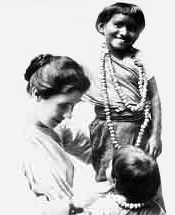
In 1894, Amy went to Bangalore, India with the Church of England Zenana Missionary Society. She quickly found that the climate of India was much better for her health. Amy became increasingly concerned about the young children who were kept as slaves in the Hindu temples. After experimenting with coffee beans and tea leaves, Amy discovered that she could darken her skin to disguise herself as Indian. She used her disguise to gain access to the Hindu temples and rescue young girls being held there. Her disguise would not have been possible if she had not had brown eyes.
During her 55-year ministry in India, Amy rescued at least 1,000 girls and started Dohnavur Fellowship in 1901. Like the church she helped start in Belfast, Dohnavur Fellowship still exists.
Amy was injured in a fall in 1931 and spent the next 20 years as an invalid, not being able to walk without assistance.
During those 20 years, she wrote 35 books.
Amy never returned to her home in Northern Ireland. She died on January 18, 1951.
She once wrote, “One can give without loving, but one cannot love without giving.
Corrie ten Boom: A Faith Heroes Unit Study



Corrie ten Boom once said that every Christian is called to be a Light of the World. She lived by example. Hers was one of the brightest lights of the Twentieth Century. Born in Amsterdam, Holland on April 15, 1892, Corrie grew up in Haarlem in her family’s home above her father’s clock shop. Corrie’s parents, Casper and Cornelia ten Boom, were committed followers of Christ and instilled in their children a love for Jesus, His Word, and His chosen people.
Corrie was the youngest of four children. Named after her mother, Corrie’s full name was Cornelia Arnolda Johanna ten Boom. She, along with her parents, sisters, brother, and three aunts, lived in the rooms above the family clock shop and jewelry store. Theirs was a crowded but loving household where service to others was a way of life. They often provided shelter, food, and even money to those in need in their community.
Corrie never married, but had a brief romance with a man named Karel. According to her account of their courtship in her book, The Hiding Place, Karel’s family expected him to marry well, and marriage to the daughter of a watchmaker was not part of their plans for him. Nevertheless, Corrie’s broken heart healed as she worked with her father in the clock shop becoming the first woman in the Netherlands to be licensed as a watchmaker. Time passed, and changes came to the Ten Boom family. Corrie’s mother and aunts died. Her brother married and moved away as God led him into full-time ministry. Her sister, Nollie, also married. Soon the crowded house they had all shared was much quieter as only Corrie, her father, and her sister, Betsie, remained. But the Ten Booms commitment to serving others continued as they began to take in foster children.
After the Nazi invasion of Holland in May of 1940, Corrie and her family remained committed to serving others and to loving the Jewish people. They became part of the Dutch underground opening their home to Jews who were fleeing Nazis persecution. The Ten Booms fed and clothed them, gave them a safe place to hide, provided them with ration cards, and helped them get out of the country to safety. They built a secret room in Corrie’s room where the refugees could hide in case of a raid by the Gestapo (Nazi secret police). Betrayed by a Nazi informant, the entire Ten Boom family was arrested when the Nazis raided their home on February 28, 1944.
Remarkably, none of the six people hiding in the hidden room was discovered. Corrie’s father died 10 days after their arrest, and Corrie and Betsie were ultimately sent to Ravensbruck, a women’s labor camp in Germany. Betsie died at Ravensbruck later that year, but due to a clerical error, Corrie was released on December 28, 1944. All of the other women her age were put to death a week later.
After the war, Corrie returned to Holland and set up rehabilitation centers for survivors of the concentration camps. She even helped Dutch citizens who had collaborated with the Germans during the occupation. She travelled to over 60 countries speaking and sharing the gospel of Jesus. She also wrote books. Her most famous book, The Hiding Place, was published in 1971, and was made into a movie in 1975.
When Corrie was 85, she moved to Placentia, California. Five years before her death, Corrie suffered two strokes which left her unable to speak. Corrie died from a third stroke on her 91st birthday in 1983, but thirty-three years after her death, Corrie ten Boom’s light continues to shine.
 Word of Truth Blog