Jesus Begins His Galilean Ministry
Matthew 4:12 marks the beginning of Jesus’ ministry in Galilee. After His temptation/testing by Satan, Jesus spends about a year in Judea. (See my lesson on the Temptation here). Matthew does not provide details of these months in Judea, but John’s gospel does. (See John 1:19 – 4:54). Here are the highlights of the events of that year:
- Jesus preached near the lower Jordan River (John 3:2-24; 4:1-3).
- The Pharisees became increasingly hostile to Jesus and His message (John 4:1-3).
- Herod arrested and imprisoned John the Baptist (Matthew 4:12).
After John’s arrest, Matthew explains that Jesus went to Galilee.
Now when he heard that John had been arrested, he withdrew into Galilee. And leaving Nazareth he went and lived in Capernaum by the sea, in the territory of Zebulun and Naphtali. (Matthew 4:12-13, ESV, emphasis added)
Galilee
Galilee is located in modern-day Northern Israel. Most of Jesus’ three-year ministry took place in Galilee, and much of His ministry in this region was in the vicinity of the Sea of Galilee.
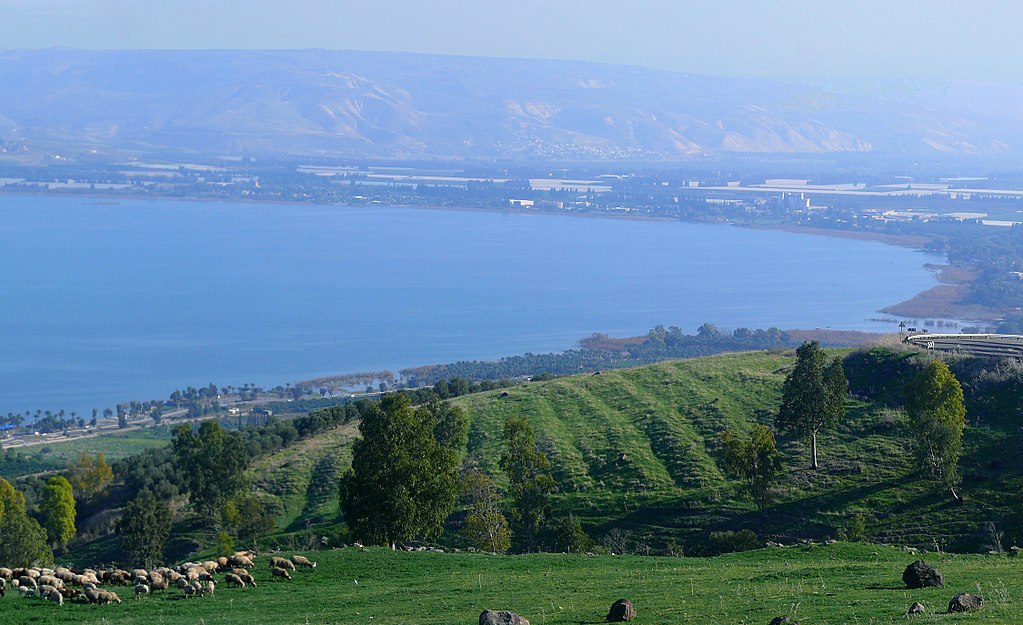
Galilee is mentioned 67 times in the Bible and figures prominently in the New Testament because so much of the gospel events occur there. The region is only mentioned seven times in the Old Testament.
- Joshua 12:23
- Joshua 20:7
- Joshua 21:32
- 1 Chronicles 6:76
- 1 Kings 9:11
- 2 Kings 15:29
- Isaiah 9:1
Most of Jesus’ public ministry occurred in Galilee including his first miracle turning water into wine (John 2:1-11) as well as the Sermon on the Mount and the Transfiguration. Most of the miracles of Jesus recorded in the gospels take place in Galilee.
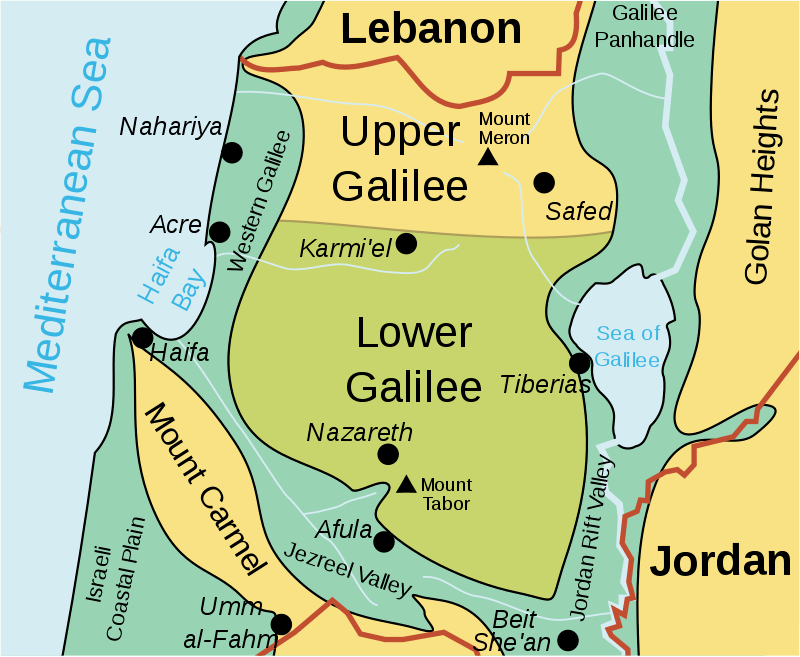
Interestingly, most of the population of Galilee at the time of Christ was Gentile which further shows us that Jesus came to seek and to save ALL the lost. He came for Jews and Gentiles alike.
Galilee was predominately Gentile in its population, but with a large number of Jewish cities and citizens. Also, Galilee was known as an incredibly fertile region. Many successful farms took advantage of the good soil.
David Guzik, http://www.blueletterbible.org
Jesus Returns to Nazareth
When Jesus returns to His hometown of Nazareth, He is rejected there. Luke 4:16-30 explains what happened in Nazareth upon His return.
And he [Jesus] came to Nazareth, where he had been brought up: and, as his custom was, he went into the synagogue on the sabbath day, and stood up for to read. And there was delivered unto him the book of the prophet Esaias [Isaiah]. And when he had opened the book, he found the place where it was written, The Spirit of the Lord is upon me, because he hath anointed me to preach the gospel to the poor, he hath sent me to heal the brokenhearted, to preach deliverance to the captives, and recovering of sight to the blind, to set at liberty them that are bruised, to preach the acceptable year of the Lord. And he closed the book, and he gave it again to the minister, and sat down. And the eyes of all them that were in the synagogue were fastened on him. And he began to say unto them, This day is this scripture fulfilled in your ears. And all bare him witness, and wondered at the gracious words which proceeded out of his mouth. And they said, Is not this Joseph’s son? And he said unto them, Ye will surely say unto me this proverb, Physician, heal thyself: whatsoever we have heard done in Capernaum, do also here in thy country. And he said, Verily I say unto you, No prophet is accepted in his own country. But I tell you of a truth, many widows were in Israel in the days of Elias [Elijah], when the heaven was shut up three years and six months, when great famine was throughout all the land; But unto none of them was Elias sent, save unto Serepta, a city of Sidon, unto a woman that was a widow. And many lepers were in Israel in the time of Eliseus [Elisha] the prophet; and none of them was cleansed, saving Naaman the Syrian. And all they in the synagogue, when they heard these things, were filled with wrath, and rose up, and thrust him out of the city, and led him unto the brow of the hill whereon their city was built, that they might cast him down headlong. But he passing through the midst of them went his way. (Luke 4:16-30, KJV, brackets and emphasis added)
Although Matthew does not provide the details of the rejection of Jesus by the people of Nazareth, he does state that Jesus left Nazareth to live in Capernaum.
And leaving Nazareth he went and lived in Capernaum by the sea, in the territory of Zebulun and Naphtali. . .(Matthew 4:13a, ESV)
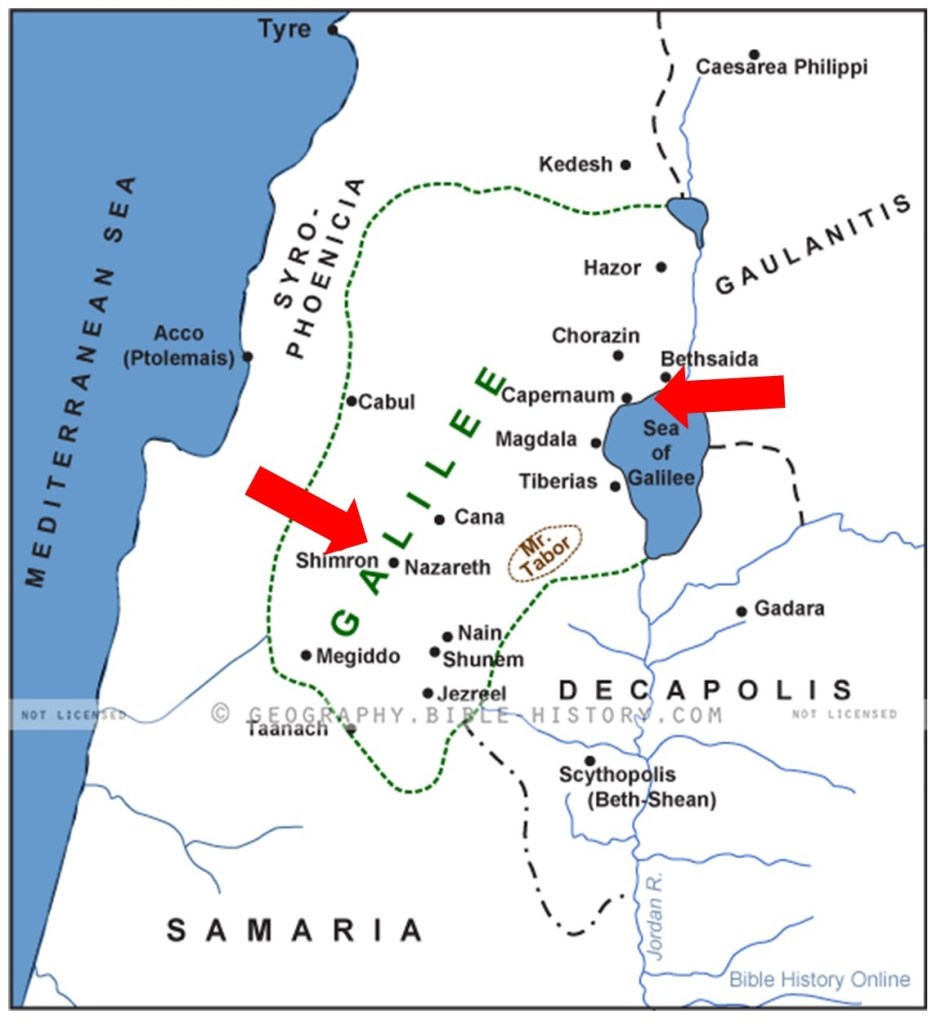
As Matthew often does in his gospel, he shows the fulfillment of prophecies about the Messiah.
. . .[S]o that what was spoken by the prophet Isaiah might be fulfilled: The land of Zebulun and the land of Naphtali, the way of the sea, beyond the Jordan, Galilee of the Gentiles—the people dwelling in the darkness have seen a great light, and for those dwelling in the region and shadow of death, on them a light has dawned. (Matthew 4:13b-16, ESV, brackets and emphasis added)
In verses 15 and 16, Matthew quotes from Isaiah chapter nine which is a passage about Yeshua/Jesus. Before describing the light which the Messiah will bring to a dark world, Isaiah describes the darkness and gloom of the world without Yeshua/Jesus.
And they will look to the earth, but behold, distress and darkness, the gloom of anguish. And they will be thrust into thick darkness. (Isaiah 8:22, ESV, emphasis added)
And then out of the darkness, the Savior is born. . .
But there will be no gloom for her who was in anguish In the former time he brought into contempt the land of Zebulun and the land of Naphtali, but in the latter time he has made glorious the way of the sea, the land beyond the Jordan, Galilee of the nations. The people who walked in darkness have seen a great light; those who dwelt in a land of deep darkness, on them has light shone. You have multiplied the nation; you have increased its joy; they rejoice before you as with joy at the harvest, as they are glad when they divide the spoil. For the yoke of his burden and the staff for his shoulder, the rod of his oppressor, you have spoken as on the day of Midian. For every book of the trampling warrior in battle tumult and every garment rolled in blood will be burned as fuel Afgovernment shall be upon his shoulder, and his name shall be called Wonderful Counselor, Mighty God, Everlasting Father, Prince of Peace. Of the increase of the government and of peace there will be no end, on the throne of David and over his kingdom, to establish it and to uphold it with justice and with righteousness from this time forth and forevermore. The zeal of the LORD of hosts [Yahweh] will do this. (Isaiah 9:1-7, ESV, brackets and emphasis added)
Jesus’ Message
After showing that Jesus’ ministry in Galilee was a fulfillment of prophecy, Matthew shares Jesus’ message.
From that time Jesus began to preach, saying, “Repent, for the kingdom of heaven is at hand.” (Matthew 4:17, ESV, emphasis added)
Repent
The first part of Jesus’ message is “Repent.” The Greek word here is the verb, metanoeó, which means “change of mind.”
Repentance involves a turning with contrition from sin to God; the repentant sinner is in the proper condition to accept the divine forgiveness.
Bruce, F.F. The Acts of the Apostles [Greek Text Commentary], London: Tyndale, 1952, p. 97)
The Kingdom of Heaven
Matthew is the only gospel writer who uses the term “Kingdom of Heaven.” He uses the term 32 times while the other gospels use “Kingdom of God.” However, although Matthew prefers “Kingdom of Heaven,” he also used the term “Kingdom of God” 4 times.
- Matthew 12:28
- Matthew 19:24
- Matthew 21:31
- Matthew 21:43
Is there a difference between the “Kingdom of Heaven” and the “Kingdom of God?” The short answers is, no, there is not. Jesus Himself did not draw a distinction between the two.
And Jesus said to his disciples, “Truly, I say to you, only with difficulty will a rich person enter the kingdom of heaven. Again, I tell you, it is easier for a camel to go through the eye of a needle than for a rich person to enter the kingdom of God.” (Matthew 19:23-24, ESV, emphasis added)
Additionally, when comparing passages in Matthew where he uses “Kingdom of Heaven” to passages in the other gospels relating the same event that use “Kingdom of God,” we can see that the terms are synonymous.
For example, in Matthew 11:11-12, Jesus is speaking about John the Baptist. He states, “Truly, I say to you, among those born of women there has arisen no one greater than John the Baptist. Yet the one who is least in the kingdom of heaven is greater than he” (ESV, emphasis added). In Luke 7:28, Luke recounts the same conversation, but he writes it this way, “I tell you, among those born of women none is greater than John. Yet the one who is least in the kingdom of God is greater than he” (ESV, emphasis added).
Another example is found in Matthew 13:11: “And he answered them, ‘To you it has been given to know the secrets of the kingdom of heaven, but to them it has not been given’” (ESV, emphasis added). Compare that verse to Mark 4:11: “And he said to them, ‘To you has been given the secret of the kingdom of God, but for those outside everything is in parables’” (ESV, emphasis added). And check out Luke 8:10: “[H]e said, ‘To you it has been given to know the secrets of the kingdom of God, but for others they are in parables, so that seeing they may not see, and hearing they may not understand’” (ESV, emphasis added).
Other Passages for Comparison
- Matthew 13:24 and Mark 4:26
- Matthew 13:31 and Mark 4:30; Luke 13:18
- Matthew 13:33 and Luke 13:20
- Matthew 18:3 and Mark 10:14; Luke 18:16
- Matthew 22:2 and Luke 13:29
There is no significant difference between “the Kingdom of God” and “the kingdom of heaven.” The one phrase emphasizes the sovereign Ruler of the kingdom and the other emphasizes the kingdom itself, but they are the same kingdom.
MacArthur, John, “What is the Kingdom of Heaven?” www.gty.org/library/bibleznas-library/QAO158/what-is-the-kingdom-of-heaven, accessed April 8, 2021.
Matthew speaks more about the Kingdom than any of the other gospels. Remember that one of Matthew’s goal is to present Jesus as King to his Jewish audience, so it is not surprising that he references the Kingdom so often. He focuses on what it is like to be part of the Kingdom of Heaven with Jesus ruling as King.
Later in chapter four, Matthew shows the connection between the kingdom and the gospel.
And he [Yeshua/Jesus] went throughout all Galilee teaching in their synagogues and proclaiming the gospel of the kingdom and healing every disease and every affliction among the people. (Matthew 4:23, ESV, brackets and emphasis added)
What is the Kingdom of Heaven/Kingdom of God?
To understand the Kingdom, we have to look at God’s Word for the answers.
When Jesus taught his disciples (and us) to pray, He says, “Your kingdom come, your will be done, on earth as it is in heaven” (Matthew 6:10, ESV, emphasis added). Jesus makes it clear that the Kingdom of Heaven/God is in Heaven but that it will be coming to Earth.
In short, the Kingdom of God is where God reigns. It is also where Jesus is King. It exists in Heaven, and it will one day exist on Earth; however, for those of us who are followers of Christ, we are already part of the kingdom. So it is both a present and a future kingdom.
[T[he kingdom of God is God’s reign—his sovereign action in the world to redeem and deliver a people and then at a future time finish it and renew his people and the universe completely.
Piper, John. “What is the Kingdom of God?” www.desiringgod.org/interviews/what-is-the-kingdom-of-god, accessed April 21, 2021.
Vine’s Expository Dictionary of New Testament Words explains it this way: The Kingdom of God is the sphere of God’s rule. Since, however, this earth is the scene of universal rebellion against God, the “kingdom” of God is the sphere in which, at any given time, His rule is acknowledged. God has not relinquished His sovereignty in the face of rebellion, demoniac and human, but has declared His purpose to establish it.
The Kingdom of God is not just a New Testament concept. The Old Testament also references the Kingdom:
- Psalm 10:16
- Psalm 29:10
- Psalm 145:13
- Daniel 2:44
- Ezekiel 37:25
- Daniel 4:3
See also these New Testament references to the Kingdom:
- 2 Timothy 4:18
- Colossians 1:13
- Ephesians 5:5
- Matthew 26:29
- 2 Peter 1:11
- John 18:36
- Luke 22:30
- Matthew 6:33
- Luke 12:31
- Daniel 2:44
- Daniel 7:13-14
Calling Four Disciples
After Matthew shares Jesus’ message of repentance, he provides some details about the calling of four of Jesus’ disciples. Matthew 4:18-22 explains how Jesus calls Peter, Andrew, James, and John to follow Him. All four men were fishermen, and it is while they are at work on the Sea of Galilee that Jesus calls them. Peter and Andrew were brothers, and James and John were brothers. Matthew states that the four fishermen, immediately followed Jesus.
The calling of these first four disciples is recorded in all four gospels. (See Mark 1:16-20 and Luke 5:4-11). It is John’s gospel that provides the most detail in John 1:35-51.
Matthew ends chapter four by stating that large crowds of people followed Jesus everywhere.
Large crowds followed him wherever he went—people from Galilee, the Ten Towns, Jerusalem, from all over Judea, and from east of the Jordan River. (Matthew 4:25, NLT)
 Word of Truth Blog