Introduction to the Gospel of Matthew
Although there are four New Testament books identified as the “Gospels,” it is important to remember that there is only one GOSPEL. Each of these four books, Matthew, Mark, Luke, and John, are unified in their message. Each one of them is about Jesus.
What is the gospel? It is the good news that Jesus, the only begotten Son of God and equal to God, took on flesh, was born as a baby, died to reconcile us to God, and rose again in victory over sin and death.
Matthew, in his gospel, establishes the fact that Jesus is not only our Savior and Lord, He is our King. This royal message is woven throughout the entire gospel. The very first words of Matthew tell us that Jesus is the “Son of David” thus establishing Jesus’ royal lineage
Themes of Matthew
- Jesus is the Messiah that the prophets in the Old Testament prophesied would come.
- Matthew also shows that Jesus is our Redeemer and King.
Fast Facts
- Written by Matthew (aka Levi), one of Jesus’ disciples
- Quotes from the Old Testament more than 60 times
- Written to Jewish believers in Jesus
- Written about A.D. 50
Authorship
Although the gospel of Matthew does not identify the author, the first century church accepted the book as the work of Matthew, one of Jesus’ disciples. The book was written to Jews who had come to faith in Christ (and also to those who had not yet accepted Him) which is why throughout the gospel, Matthew continually shows Jesus as the fulfillment of Old Testament prophecies concerning the Messiah. He quotes from the Old Testament more than 60 times.
The Bible tells us very little about Matthew, the disciple. Matthew himself tells us about his call to follow Jesus in Matthew 9.
As Jesus passed on from there, he saw a man called Matthew sitting at the tax booth, and he said to him, “Follow me.” And he rose and followed him. And as Jesus reclined at table in the house, behold, many tax collectors and sinners came and were reclining with Jesus and his disciples. And when the Pharisees saw this, they said to his disciples, “Why does your teacher eat with tax collectors and sinners?” But when he heard it, he said, “Those who are well have no need of a physician, but those who are sick. Go and learn what this means: ‘I desire mercy, and not sacrifice.’ For I came not to call the righteous, but sinners.”
Matthew 9:9-13, ESV
.
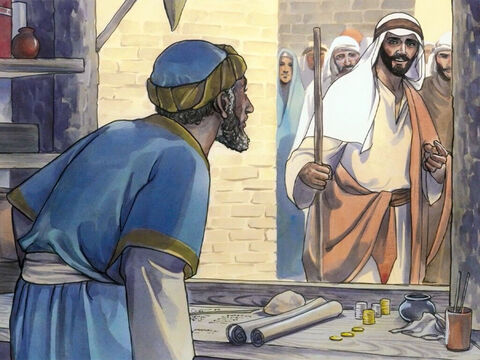
So Matthew himself records that he was a tax collector. (Some translations refer to tax collectors by the older term, “Publican.”) Tax collectors worked for the Roman government and were usually despised because they over-charged taxes and kept the excess for themselves.
Luke tells us more about Matthew’s conversion than Matthew does. Note that Luke refers to Matthew by his Hebrew name, Levi.
After this he went out and saw a tax collector named Levi [Matthew], sitting at the tax booth. And he said to him, “Follow me.” And leaving everything, he rose and followed him. And Levi [Matthew] made him a great feast in his house, and there was a large company of tax collectors and others reclining at table with them. And the Pharisees and their scribes grumbled at his disciples saying, “Why do you eat and drink with tax collectors and sinners?” And Jesus answered them, “Those who are well have no need of a physician, but those who are sick. I have not come to call the righteous but sinners to repentance.
Luke 5:27-32, ESV, emphasis and brackets added
Mark also mentions Matthew’s call to follow Christ in his gospel. Notice that Mark gives us a little bit more information about Matthew, telling us his father’s name.
And as he passed by, he saw Levi [Matthew] the son of Alphaeus sitting at the tax booth, and he said to him, “Follow me.” And he rose and followed him. And as he reclined at table in his house, many tax collectors and sinners were reclining with Jesus and his disciples, for there were many who followed him. And the scribes of the Pharisees, when they saw that he was eating with sinners and tax collectors, said to his disciples, “Why does he eat with tax collectors and sinners?” And when Jesus heard it, he said to them, “Those who are well have no need of a physician, but those who are sick. I came not to call the righteous, but sinners.”
Mark 2:14-17, ESV, emphasis and brackets added
Matthew’s humility is apparent in the fact that he identifies himself as a sinner in Matthew 9:9-13 but does not mention that he prepared a feast for Jesus and that he gave up everything to follow Christ as we find out from Luke’s account.
According to some traditions, Matthew first penned his book in Hebrew and later re-wrote it in Greek. (1) This may be true considering who Matthew was writing to, but since there is no surviving Hebrew text of the book, we cannot know this for certain.
NOTE: Some Bible scholars doubt Matthew’s authorship of the gospel believing that the book draws heavily on Mark’s gospel. They argue that since Matthew was a disciple and personally witnessed Jesus’ ministry, he would not have had to rely on Mark’s account.
Although the first Gospel is anonymous, the early church fathers were unanimous in holding that Matthew, one of the 12 apostles, was its author. However, the results of modern critical studies — in particular those that stress Matthew’s alleged dependence on Mark for a substantial part of his Gospel — have caused some Biblical scholars to abandon Matthean authorship. Why, they ask, would Matthew, an eyewitness to the events of our Lord’s life, depend so heavily on Mark’s account? The best answer seems to be that he agreed with it and wanted to show that the apostolic testimony to Christ was not divided.
www.biblestudytools.com
The most important fact to note about the authorship of any book in the Bible is that God through the Holy Spirit is the ultimate author. Although He used men to write His Word, God is the author of the entire Bible.
All scripture is breathed out by God and profitable for teaching, for reproof, for correction, and for training in righteousness, that the man of God may be complete, equipped for every good work.
2 Timothy 3:16, ESV
Historical Context
The majority of biblical historians agree that Matthew was probably written about A.D. 50 before the destruction of the temple in A.D. 70, so it was written early in the history of the church. Most believers at that time were Jews, and many of the apostles ministered to Jews, so it is not surprising that Matthew’s audience was made up primarily of Jews who would have been familiar with the Messianic prophecies of the Old Testament. The book of Acts provides us with ample evidence that the gospel message was first preached to Jews only.
So then those who were scattered because of the persecution that occurred in connection with Stephen made their way to Phoenicia and Cyprus and Antioch, speaking the word to no one except to Jews alone.
Acts 11:19, NASB, emphasis added
Matthew’s audience were Jews who knew the Old Testament, so Matthew gives additional credibility to his message to them by providing them with proof texts from the Old Testament. They were undoubtedly a people steeped in Jewish tradition and knew the prophecies concerning the promised Messiah well. Matthew quotes from the Old Testament more than 60 times which is more than any other gospel writer.
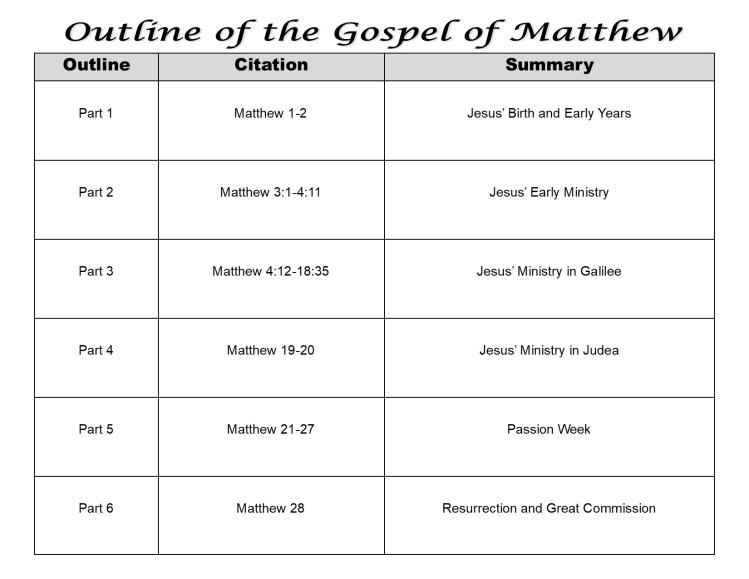
Simple Outline
Conclusion
Matthew’s gospel was written to them; however, it was written for us as well. The evidence that Matthew gives to readers today is equally important because we can clearly see that Jesus fulfilled prophecies written hundreds of years before His birth. He not only fulfilled them, He fulfilled them perfectly. My prayer for you as you study Matthew with me is that seeing these Messianic prophecies fulfilled in Jesus will strengthen your faith and give you powerful tools as you share Him with a skeptical world.
 Word of Truth Blog