Introduction
Matthew 2 is one of the most recognized passages in the entire gospel because it is part of the Christmas story. Although the narrative does not take place at the time of Jesus’ birth, it records the visit from the magi (wise men) and also tells about the flight of the young family to Egypt.
The details of Jesus’ birth and early life are only recorded in Luke’s gospel and Matthew’s gospel. Luke records the actual birth of Jesus followed by the angelic appearance to the shepherds and the shepherds’ visit to the stable where the newborn King was born.
Joseph also went up from Galilee, from the city of Nazareth, to Judea, to the city of David which is called Bethlehem because he was of the house and family of David, in order to register along with Mary, who was engaged to him, and was with child. While they were there, the days were completed for her to give birth. And she gave birth to her firstborn son; and she wrapped Him in cloths, and laid Him in a manger, because there was no room for them in the inn. In the same region there were some shepherds staying out in the fields and keeping watch over their flock by night. And an angel of the Lord suddenly stood before them, and the glory of the Lord shown around them; and they were terribly frightened. But the angel said to them, “Do not be afraid; for behold, I bring you good news of great joy which will be for all the people; for today in the city of David there has been born for you a Savior, who is Christ the Lord. This will be a sign for you: you will find a baby wrapped in cloths and lying in a manger.” And suddenly there appeared with the angel a multitude of the heavenly host praising God and saying, “Glory to God in the highest, and on earth peace among men with whom He is pleased.” When the angels had gone away from them into heaven, the shepherds began saying to one another, “Let us go straight to Bethlehem then, and see this thing that has happened which the Lord has made known to us>’ So they came in a hurry and found their way to Mary and Joseph, and the baby as He lay in the manger. When they had seen this, they made known the statement which had been told them about this Child. (Matthew 2:4-17, NASB)
Luke tells us about the visit of the common folk, represented by the shepherds. Matthew, however, shows that although Jesus came for everyone, He is a King. The magi come to see a king, and King Herod is threatened by the birth of a king.
Outline
- Visit of the Magi (2:1-12)
- Flight to Egypt (2:13-23)
Visit of the Magi (Matthew 2:1-12)
The visit of the magi is not recorded in any other gospel. Matthew records the visit because he wants to show his Jewish audience that Jesus is the true King of the Jews.
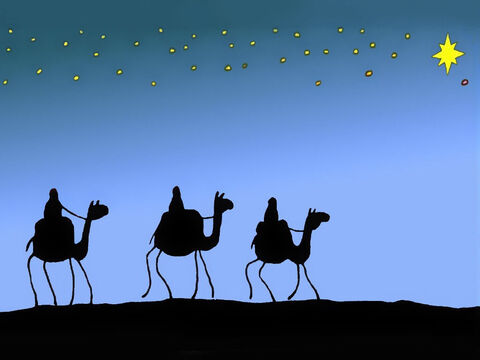
THE MAGI
- The magi were “wise men,” who probably served a role similar to Daniel in Daniel 2. They were learned men who may have been advisors to kings.
- The magi came “after Jesus was born in Bethlehem,” and they came “from the east” (v. 1). We aren’t told exactly where they came from, but most Bible scholars believe they came from the area of modern-day Iraq or Iran. They have determined this because of the amount of time it took them to arrive. Another reason to infer that they came from Babylon or Persia is that they had knowledge of the Old Testament scriptures regarding the coming of Messiah. When the Babylonians conquered the southern kingdom of Judah, they took thousands of captives back to Babylon. Many of the descendants of those captive still resided in Babylon and Persia. (See 2 Kings 24-25) The magi may have been Jewish, or they may have learned the scriptures from their Jewish neighbors. I believe they were Jews because they referred to Jesus as the “King of the Jews” (v. 2) and because they worshipped Him (v. 11) They obviously believed in Yahweh since they came so far to worship his Son, the Savior and King and because they immediately obeyed when God warned them in a dream not to return to Herod, they obeyed without question (v. 12).
- The magi visited Jesus in a house (v. 11). They were not present on the night of His birth in the stable (contrary to popular Christmas images that place them there).
- Matthew does not tell us how many magi there were (v. 1) All we know is that there was more than one because the Greek word used in verse one is Magos which is a plural noun. They are usually referred to as “the three wise men;” however, there were probably more than three. They had to travel at least 1400 miles to get to Bethlehem, and such a journey would not have been safe for three lone travelers. Their entourage probably included a large number of people. We know for certain that their presence in Jerusalem caused quite a stir since Matthew states that Herod “was troubled, and all Jerusalem with him.” (v. 3)
- The magi were wealthy and powerful men. King Herod treats them with respect. Also, they give Jesus, Mary, and Joseph expensive gifts. These gifts probably made the young family’s costly flight to Egypt possible.
“[O]ne of the objects of their visit which they themselves knew not, was to supply money for the child’s flight to Egypt. The parents were poor, and, except for the gold brough by the Wise-Men [magi], escape from Herod may not have been possible.”
Halley’s Bible Handbook
THE STAR
There has been much speculation about the star that the magi followed to Bethlehem. Many have tried to explain it away as an actual astronomic phenomenon.
- Astronomers and historians have pointed out that there was a conjunction of Jupiter and Saturn in 6 B.C. that would have looked like a bright star, and everyone would have noticed that. However, it is obvious from the text that no one but the magi could see the star. When they arrived at Herod’s court in Jerusalem, they refer to it as “His star” (v. 2), and no one else had noticed it.
- The “star” led them. It “went on before them until it came and stood over the place where the Child was” (v. 9)
- The word translated “star” in our English translations is from the Greek word aster which means a celestial body. However, it is also used several times in the New Testament to refer to an angel. (See Revelation 9:1 and 12:40). It is also used to describe Jesus as “the bright morning star” in Revelation 22:16. It is possible that what the magi described to Herod as a star was an angel that God had sent to lead them to Jesus.
KING HEROD
King Herod is truly the villain of the Christmas story. He lies to the magi telling them that he wants to know where the child (Jesus) is so that he can also worship him (v. 8). Herod actually wants to destroy the new King. He considered himself to be the “King of the Jews,” so he perceived the Child-King to be a threat to his reign.
Who exactly was Herod and how did he become a king?
- According to historians, Herod was born in Ashkelon, a seaport town on the Mediterranean Sea in 73 B.C.
- He was an Edomite or Idumean which means he was a descendant of Esau, brother of Jacob. However, because there was much intermarrying between Edomites and Jews, he may have been part Jewish although he was not known to have kept Jewish law.
- He was named “King of the Jews” by the Roman Senate under the Roman Emperor, Octavian in 40 B.C.
- Herod was a brutal ruler who killed his wife, Marianne, her mother and brother, and two of his sons with her because he though they were going to overthrow him. According to www.biblegateway.com, Augustus Caesar is said to have stated, “It is better to be Herod’s dog than one of his children.”
- It is not surprising that a man who would murder two of his own sons would have no qualms about killing all of the boys two and under (v. 16).
THE GIFTS OF THE MAGI
The reason we usually think of three magi is because they brought the child, Jesus, three gifts: gold, frankincense, and myrrh. Each of the gifts has a prophetic significance.
- Gold has always been associated with royalty. Giving the young Jesus a gift of gold confirmed what the magi had already proclaimed in verse 2. They had come prepared to honor a King. 1 Kings 10:14 tells of the gold of King Solomon.
- In the Old Testament, frankincense is associated with the priesthood. It is a resin used to make incense. God explains to Moses how it was to be used by the priests in Exodus 30:34-36. This gift is significant because Jesus is both King and Priest. Hebrews 5 describes Jesus as a priest “according to the order of Melchizedek” (vs. 6, 10). See Hebrews 7:1-4 and Genesis 14:18-20 for more on Melchizedek.
- Myrrh is an embalming spice. This gift looks to the time of Jesus’ death. Although He is our King and High Priest, He is also our Savior who came to die for our sins so that we can be reconciled to God.
Flight to Egypt (2:13-23)
The account of the flight of Joseph, Mary, and the young child, Jesus to Egypt is not recorded in any of the other gospels. Matthew states that “an angel of the Lord appeared to Joseph in a dream” and told him to take his family and flee to Egypt because Herod was going to try to kill Jesus. This is the second time that God had spoken to Joseph in a dream. The first was when He told Joseph that the child Mary was carrying was from God and that she had not been unfaithful to him (Matthew 1:20-21).
Does God still speak through dreams?
The Bible provides numerous examples of God’s speaking to His people through dreams. We have already seen two such examples in Matthew.
- Joseph’s prophetic dreams got him in trouble with his family in Genesis 37.
- God appeared to Solomon in a dream when He asked the young king what he wanted most. Solomon famously asked for wisdom. (See 1 Kings 3).
- God gave Daniel his vision about events and kingdoms to come (recorded in Daniel 7) in a dream.
- Peter was given permission to eat unclean animals in a dream (Acts 10:9-16).
The God who spoke in dreams and visions in the Bible is the God we serve today. His Word tells us that He never changes. “Jesus Christ is the same yesterday and today and forever” (Hebrews 13:8, NASB).
We are told that God will continue speaking directly to His people even in the last days.
And it shall come to pass afterward, that I will pour out my Spirit on all flesh; your sons and your daughters shall prophesy, your old men shall dream dreams, and your young men shall see visions. (Joel 2:28, ESV)
Peter quotes Joel 2:28 in his sermon on the Day of Pentecost recorded in Acts 2:17-21 thereby acknowledging that the days after Jesus ascension are “the last days.” Therefore, the last two thousand years are “the last days.” It seems like a long time to us, but Peter reminds us that “with the Lord one day is as a thousand years, and a thousand years as one day.” (2 Peter 3:8b, ESV)
Yes, God still speaks directly to His people, but He primarily speaks through His written Word, the Bible. God will NEVER give a word through a dream or vision that contradicts the Bible.
Herod Kills the Children (Matthew 2:16-18)
Remember King Herod, the villain of the Christmas story? Verses 16 through 18 tell us exactly why. After the magi did not return to Jerusalem, Herod became so angry that he had all of the boys ages two and under killed which is why God told Joseph to take Mary and Jesus to Egypt.
This tragic event was prophesied in Jeremiah 31:15: “Thus says the LORD, ‘A voice is heard in Ramah, lamentation and bitter weeping, Rachel is weeping for her children; she refuses to be comforted for her children, because they are no more.” (NASB) Matthew confirms that Jeremiah 31:15 is speaking of this event when he states, “Then what had been spoken through Jeremiah the prophet was fulfilled: A voice was heard in Ramah, weeping and great mourning, Rachel weeping for her children; and she refused to be comforted, because they were no more.” (Matthew 2:17-18, NASB)
Move to Nazareth (Matthew 2:19-23)
When God sent Gabriel to the young virgin, Mary, to tell her she had been chosen to be the mother of the Messiah, he appeared to her in Nazareth, her hometown.
Now in the sixth month the angel Gabriel was sent from God to a city in Galilee called Nazareth, to a virgin engaged to a man whose name was Joseph, of the descendants of David; and the virgin’s name was Mary. (Luke 1:26-27, NASB)
After Herod’s death, God once again spoke to Joseph in a dream and told him that is was safe for him to take his family back to Israel (Matthew 2:19-23). The family then returned to Nazareth (v. 23) where Jesus would spend the rest of his early years.
Read these passages to dig deeper into this study:
- Micah 5:2
- Hosea 11:1
- Numbers 24:8
- Exodus 4:20
- Jeremiah 31:15
 Word of Truth Blog